Apple Computer Setup and Installation of Basic Software Programs

20140314fr-apple-computer-basic-setup-guidelines-640x300

Summary

This article offers some basic steps for setting up a new Apple computer. It’s written for the beginner, but an advanced user can quickly skim the points emphasized in bold. This is the general process that a support technician would go through when setting up a new Apple computer.

Glossary

For those new to Apple computers, this glossary provides an introduction to some common terms that will be used in the instructions below.

  • Dock. The Dock is a row of icons that spans the bottom edge of your screen. It can be customized to show up on the left or right edge of the screen. It can also be customized to hide when not being used. The Dock is where you can place icons to commonly used programs, files, or folders.
  • Finder. The Finder is a system browsing tool that lets you explore your files on your computer. It’s similar to Windows Explorer. To access it, click on the face icon in the lower left on the Dock. You are “in the finder” if a menu across the top left of the screen shows Finder, File, Edit, View, Go, Window, and Help as shown below. This can appear when no programs are running and no windows are open. In addition to being “in the finder” you can also have the Finder browser window open when you exploring folder and devices as shown (partially) below. When you click an item on the left, its contents show on the right.
    20140314fr-finder-browser-window

Startup Installation Media

If you’re working with a brand-new computer, then skip to the next section below. However, if you’re reinstalling the operating system, perhaps after installing a new hard drive, or recovering after some other malfunction, then you’ll need the original system media. If you’ve lost the original system discs, you could try these steps:

  1. Internet Recovery. If you have a newer Apple computer (one that came with OS X Lion or later) you can hold down Command-R during startup to use Internet Recovery. This will restore your computer from the Internet (and skip steps #2 and #3 below). If your Apple computer cam with OS X Snow Leopard or earlier, then you’ll need startup media (described in step #2).
  2. Mountain Lion OS X 10.8 Disc. Find someone who has a startup system DVD for Mountain Lion. Put the disc in the drive as you’re turning on the computer while holding down the “C” on the keyboard. This will start to the CD drive media.
  3. Mavericks. Once you’ve installed Mountain Lion, you can go to the App Store and install Mavericks. You’ll need an Apple ID to login to the store, but no payment will be required.

Apple iLife and iWork Software

New Apple computers come with the full suite of iLife and iWork software. The iLife suite includes iMovie, iPhoto, and GarageBand. The iWord suite includes Keynote, Numbers, and Pages. If you installed the operating system from the original discs that came with your computer, any software that came with the computer should be installed again. However, if you recovered the computer using standard OS installation media, then you’ll need to install these software programs separately. If you previously purchased them from the App store, they can be downloaded and installed again for free from the App store. However, if they originally came with your computer and now you’ve lost your originally installation discs, then you’ll need to purchase these from the App store.

Initial Startup User Settings

When you first turn on the computer (or during the installation procedure), you’ll be asked to choose a standard language, provide a profile picture, and enter your Apple ID. The Apple ID is used as a single authentication login for purchases and iCloud data. However, you may want to keep separate accounts for these as explained below.

Import From Backup or Computer

At some point you may be asked if you’d like to import from another Apple computer or TimeMachine backup. If you’ve purchased a new computer to replace an existing computer that is still working, then you can transfer your programs, settings, and data from the old computer to the new one. This can also be done using a TimeMachine backup.

You can import during the initial startup (or rebuild) of a new computer or you can also wait until later and choose the Migration Assistant (found in Utilities). It’s better to wait until later.

It’s likely that the computer you’re importing from has all of the latest updates. A new computer out of the box will require updates before an import can be performed. In fact, this is probably the message you’ll receive if you attempt to migrate.

Make sure the old computer and new computer have any available updates installed.

Apple ID and iCloud User Accounts

It’s best to maintain separate iCloud and Apple ID user accounts. Your iCloud data is personal and unique to you (calendar, contacts, email, tasks, reminders). The Apple ID is used for purchases of hardware, software programs, apps, music, movies, and other products or services.  It’s likely that you’ll want to share these purchases across multiple computers. For example, a family could have several computers all authenticated to the App Store for shared software. However, those same computers might be configured for different iCloud user accounts. In fact, a single computer may have one Apple ID used for software purchases, but several user login accounts that offer each person their own synchronized iCloud data.

Apple Mac Computer Basic User Settings

The following instructions offer some suggested user settings for a new Apple computer. These will help you navigate the computer better.

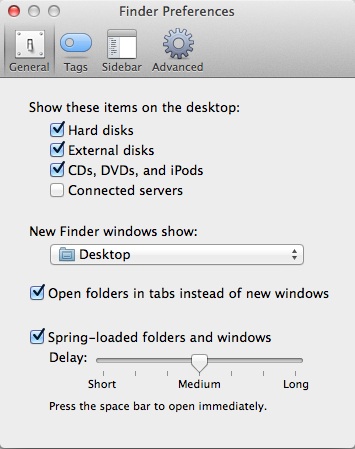
  1. Hard Drive Icon. By default, the hard drive icon is not visible on the desktop or in the finder viewer. External disks as well as CDs, DVDs, and iPods are not displayed either. Many users would prefer to see these devices. To enable these, from the Finder menu, choose Preferences, then select the devices you’d like to have visible on the desktop.
    20140313th-finder-preferences
  2. New Finder Windows Show. By default, when you open a new Finder window, you’ll see the All My Files listing of files. This is a categorized listing of all your files. However, most people are either working with recent files on their desktop or in specific project folders within their Documents folder. To change what folder or location is showing when opening the Finder, go to Finder Preferences and choose Desktop (for example) under the New Finder windows show option. This is shown above.
  3. Show Hard Drive in Finder Window. By default, the hard drive doesn’t show in the Finder browser. You can click and drag it from the desktop into an open Finder window under the Sidebar heading Favorites as shown below. The blue line appears to show where the drive will be listed. Other files, folders, and devices can be placed in the Favorites area of the sidebar. This is identical to the Windows Explorer.
    20140314fr-apple-setup-finder-sidebar-favorites-hard-drive-display-show
  4. Show Applications Folder in Dock. By default, the Applications folder isn’t readily available. So, to run a program, it’s necessary to find it first. It’s much easier to have the Applications folder in the dock. From the Finder browser, click on the Macintosh HD or whatever your hard drive name is. Click and drag the Applications folder to the Dock to the right of the faint divider bar. Then lift up on the mouse button. Click the image below for a larger view.
    20140314fr-drag-applications-folder-to-dock
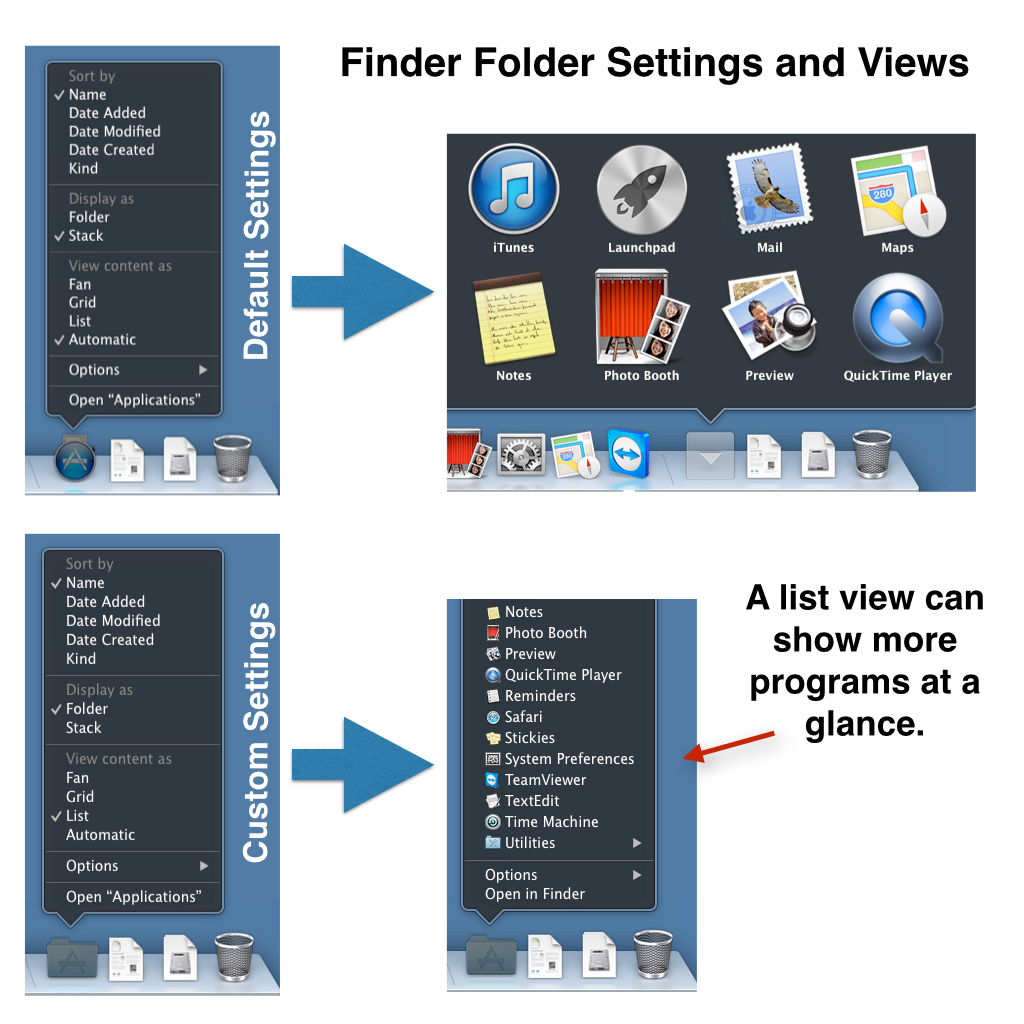
  5. Applications List View. By default, the Applications listing will be a Grid view as shown below. If you switch to Display as Folder and View content as List, it will be possible to see more programs at a glance and easily scroll through them. These settings and the results can be seen below. Click the image for a larger view.
    20140314fr-applications-folder-view-1024x1024
  6. Show Documents Folder in Dock. For many people, the documents folder is a frequently accessed folder. If this is true for you, or if there’s another folder you need access to regularly, use the Finder browser to locate that folder in the hard drive and then drag it to the Dock just as you did with the Applications folder. Also set that folder to Display as Folder and View content as List.
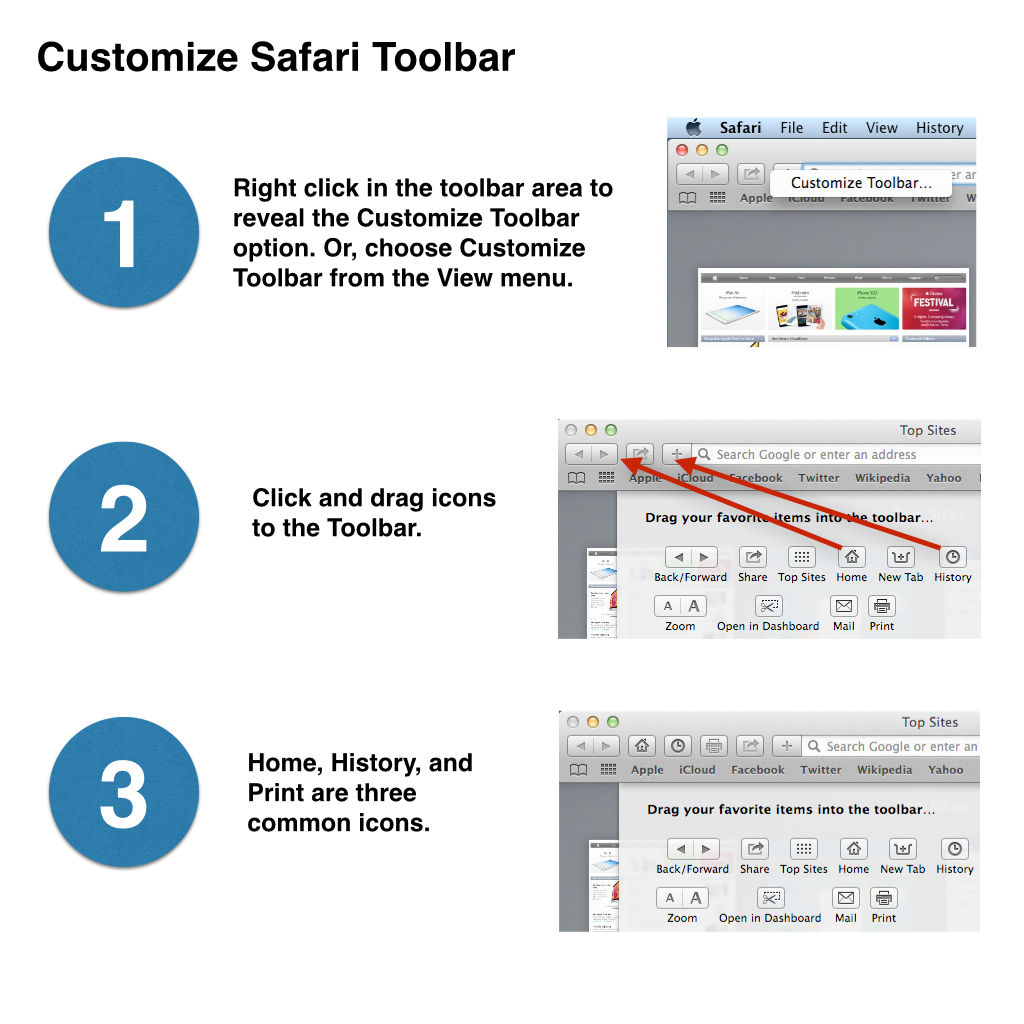
  7. Safari Customize Toolbar. By default, the Safari Toolbar won’t display a History icon. Right click next to the website address display and choose Customize Toolbar as shown below. Then, click and drag the desired shortcut icons to the toolbar as shown below. Click the image for a larger view.
    20140314fr-safari-toolbar-customization1024x1024
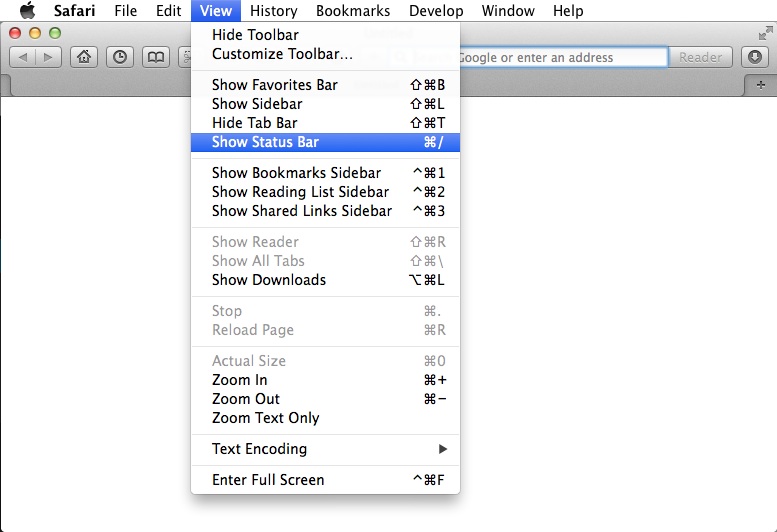
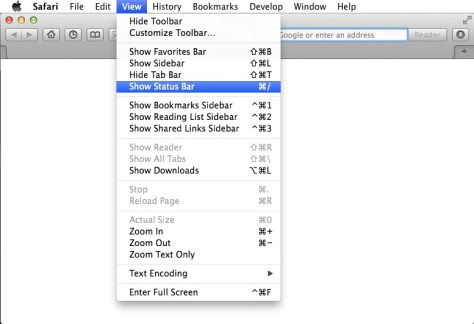
  8. Safari Status Bar. There are times when it’s helpful to know a link URL address (the website address of a hyperlink) without clicking on it and opening the page. The Status bar at the bottom of the Safari browser window makes this possible. Choose Show Status Bar from the View menu (as shown below).
    20140314fr-apple-mac-safari-status-bar-show-777x532
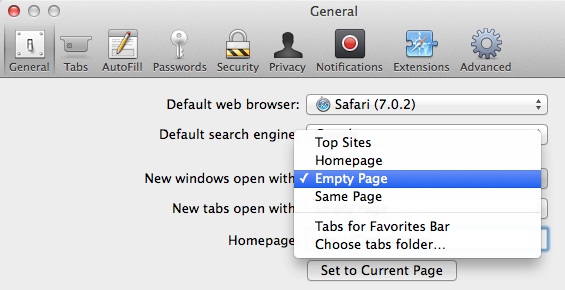
  9. Safari Home Page and Start Page. Safari has three settings that relate to start pages. You can set the home page (the page you go to when you click the home icon). You can define the page displayed when you open a new window. You can also set the page displayed when you open a new tab. Google is a common setting for all of these since often people perform a search when they go to web.
    20140314fr-apple-mac-safari-home-page-tab-new-668x520
    Another possible setting for these options is to choose blank page.
    20140314fr-apple-mac-safari-home-page-tab-blank-565-290

Basic Apple Computer Software

These are some basic operational programs that should be installed on an Apple computer.

  1. TeamViewer. It can take many hours to setup a computer, and much of that time is spent waiting for updates and installations. For this reason, it’s helpful to setup computers remotely; checking in throughout the day to continue with the process. TeamViewer is a free program that lets you access computers remotely.
  2. Adobe Reader. Apple computers come with the Preview utility and the ability to view a wide array of program files even if you don’t own the software used to create those files. However, it’s helpful to have Adobe Reader for additional features when viewing PDF files.
  3. Adobe Flash. Many websites require Adobe Flash to display much of their content.
  4. Microsoft Silverlight. Many Microsoft websites use Microsoft Silverlight. Like Adobe Flash, it’s a platform for development of website animation and other features.
  5. Flip4Mac. Apple computers don’t natively have the ability to play Windows Media Video (WMV) video files.
  6. Mozilla Firefox. Some websites are best viewed using a specific browser such as Mozilla Firefox or Google Chrome. So, it’s a good idea to install these.
  7. Google Chrome. Some websites are best viewed using a specific browser such as Mozilla Firefox or Google Chrome. So, it’s a good idea to install these.
  8. LibreOffice. Libre Office is a free alternative to Microsoft Office.
  9. Microsoft Office 365. At a cost of $100 per year, you can have the full Microsoft Office suite for use on up to five computers (Mac or Windows). This isn’t required, but may be necessary if you absolutely need to use Microsoft Office software products.
FTP Software for Apple Mac Computers

20140311tu-ftp-software-for-apple-mac-computers-640x300

There are several effective and free FTP software programs available for Apple Mac computers. Occasionally you will find that one program works better than another with a particular server or hosting company. The programs listed below are provided with links for more information.

Cyberduck

20140311tu-cyberduck-icon-logo-200x236Cyberduck. Connecting to every server. With an easy to use interface, connect to FTP (File Transfer Protocol), SFTP (SSH Secure File Transfer), WebDAV (Web-based Distributed Authoring and Versioning), Amazon S3, Google Cloud Storage and Rackspace Cloud Files.

Fetch

20140311tu-fetch-ftp-utility-software-apple-mac-275x217Fetch. Fetch is a reliable, full-featured file transfer client for the Apple Macintosh whose user interface emphasizes simplicity and ease of use. Fetch supports FTP and SFTP, the most popular file transfer protocols on the Internet for compatibility with thousands of Internet service providers, web hosting companies, publishers, pre-press companies, and more.

  • Support for FTP, SFTP, and FTP with TLS/SSL (FTPS)
  • Droplet shortcuts for easy uploading
  • Synchronize folders using the Mirror command
  • Support for drag-and-drop of files and folders between servers and your Mac, or between two servers
  • Automatic resume of stalled or failed uploads and downloads
  • Quick Look support for previewing files on servers
  • Edit any kind of file and the changes will automatically be saved back to the server
  • Compatibility with virtually all FTP servers, including VMS, VM/CMS, OS/2, Chyron, and more

FileZilla

20140311tu-filezilla-ftp-utility-software-apple-mac-243x239FileZilla. The FileZilla Client is a fast and reliable cross-platform FTP, FTPS and SFTP client with lots of useful features and an intuitive graphical user interface.

Among others, the features of FileZilla include the following:

  • Easy to use
  • Supports FTP, FTP over SSL/TLS (FTPS) and SSH File Transfer Protocol (SFTP)
  • Cross-platform. Runs on Windows, Linux, *BSD, Mac OS X and more
  • IPv6 support
  • Available in many languages
  • Supports resume and transfer of large files >4GB
  • Tabbed user interface
  • Powerful Site Manager and transfer queue
  • Bookmarks
  • Drag & drop support
  • Configurable transfer speed limits
  • Filename filters
  • Directory comparison
  • Network configuration wizard
  • Remote file editing
  • Keep-alive
  • HTTP/1.1, SOCKS5 and FTP-Proxy support
  • Logging to file
  • Synchronized directory browsing
  • Remote file search

Purchasing and Installing Windows 8.1 From Scratch for a Fresh Installation

20140311tu-windows-8-1-purchase-installation-dvd-usb-upgrade-640x300

Instructions

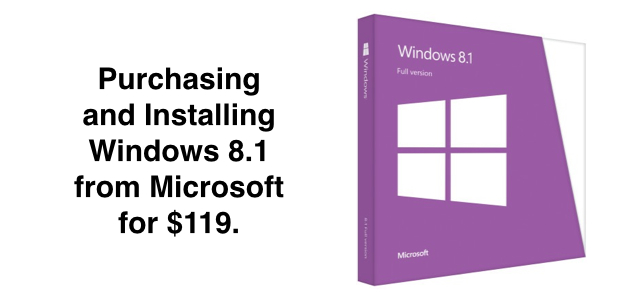
Here are the basic steps required to purchase and install Windows 8.1 from Microsoft.

  1. Windows 7 Installation. You’ll need a working Windows computer to perform some of the steps below. If you’re wanting to start with a fresh computer installation, find an original Windows 7 Pro installation DVD (assuming you have a recent Dell computer) and use that DVD to perform a fresh installation. Otherwise, continue to the next step.
  2. Microsoft Store. Go to the Windows 8.1 product page in the Microsoft Store.
    • You’ll see a message stating: “Windows 8.1 full version is for Windows 7 users only. Currently running Windows Vista or XP? First upgrade to Windows 8. Upon installation you can update to 8.1 for free.”
    • This notice somewhat misleading. This version of Windows 8.1  doesn’t require Windows 7. The installation DVD that you’ll create from the download (or have shipped to you) should work find for a fresh installation of Windows 8.1 without a required upgrade.
  3. Purchase. Purchase the English Download for $119 if you don’t want to wait for a DVD to arrive. This will give you a WindowsSetupBox.exe file and a license number. There are three benefits to this option:
    • This will provide you with an ISO image that you can burn to DVD.
    • This procedure will also give you the option to create a Windows 8.1 Installation USB flash drive.
    • You can also use this option to upgrade an existing Windows 7 computer (without creating a DVD or USB).
  4. Run Windows Setup. When the purchase process is completed, you’ll have a license number and a Windows Setup file called WindowsSetupBox.exe that you can run. This will actually initiate the download of the full Windows 8.1 installation software.
  5. Burn DVD. Assuming you have access to a computer, burn the ISO image to a DVD. This can be used later for reinstallation, repair, or recovery.
  6. Create USB. Having a Windows 8.1 installation USB flash drive is handy. With it, you can startup your computer to USB for installation similar to using a DVD but typically much faster.
  7. Choosing Upgrade or Install. If you perform an upgrade from Windows 7, your programs, settings, and personal data will be retained. However, any malware, viruses, or other unnecessary files will be retained. So, it may be preferable to backup your files and then startup the computer using the DVD or USB (described above), then format the hard drive (erasing everything) and perform a fresh clean installation of Windows 8.1. This will make your computer like new as if it were purchased from the store.
  8. Begin Installation. Assuming you want to do the fresh installation, and you have backed up your data, start the computer with the DVD or USB. You will be walked through the setup process. If you’re on a Dell computer, you will need to press F12 at startup to display the boot up options. Select the DVD drive from the list if you’re using the DVD.
  9. Upgrade or Custom. At some point you’ll be asked if you’d like to perform an upgrade or custom installation. Choosing custom is helpful because you can format the hard drive and start completely fresh. In doing so, you’ll be presented with a window showing your current drive partitions. There may be a 100MB system reserved partition for Windows 7 and another partition for the operating system. In the advanced mode you can delete these partitions. Then click New to start again. This time, Windows 8.1 will create a 350MB System Reserved partition and then the remaining drive space can be used for the Windows 8.1 installation.
  10. Settings. When you get to a Settings window, you can choose Use express settings.
  11. Sign in to your Microsoft account – NOT. You’ll be asked to sign in using your Microsoft account. This appears to be a requirement of using Windows 8.1. However, it’s not necessary. Don’t click on the Don’t have an account option because you’ll be required to create an account. Instead, click on the option to Create a new account (found under Don’t have an account?). You’ll be taken to the Create a Microsoft account screen. At the bottom of the screen, in faint thin small letters, you’ll see an option to Sign in without a Microsoft account. Choose that option.
  12. Your Account. If you’ve followed the instructions to this point, you should reach a Your account screen. Enter a user name and password just as you might have with the previous versions of Windows.
  13. General Windows Setup. You can now continue with the general Windows setup instructions.

Update to Windows 8.1 Pro from Windows 8 Pro

20140226we-microsoft-windows-8-support-tips-1024x768

Summary

Windows 8.1 and Windows RT 8.1 build on Windows 8 and Windows RT, to bring you enhancements in personalization, search, apps, the Windows Store, and cloud connectivity, and has the security and reliability features you expect from Windows. It’s fast and made to work on a variety of devices—especially on the new generation of touch devices.

If your PC is currently running Windows 8 or Windows RT, it’s free to update to Windows 8.1 or Windows RT 8.1. And unlike previous updates to Windows, you’ll get this update from the Windows Store.

Source

The instructions below are from a support document on the Microsoft.com website. (source) This is being shared here for easier access and reference.

1. Before you begin

The system requirements for Windows 8.1 and Windows RT 8.1 are nearly the same as the requirements for Windows 8—if your PC is already running Windows 8 (or Windows RT), in most cases, you can get the free update to Windows 8.1 (orWindows RT 8.1).

But before you begin, here are some things to keep in mind.

  • Your files, desktop apps, user accounts, and settings come with you. Windows 8.1 and Windows RT 8.1 come with some new built-in apps, and it will update or replace some of your existing built-in apps. Your existing Windows Store apps don’t come with you, but once the update is complete, you can reinstall all of these apps at once—or just the ones you want. For more info, see the Welcome to the new Windows section of this page.
  • We’ll check your desktop apps and devices for you. As part of the update, we check your current desktop apps and connected devices, and let you know what you’ll need to do to get them ready for the update, or to get them working again after the update. In most cases, you won’t need to do anything—most desktop apps, devices (like printers), and network connections will work normally after the update. If you have particular desktop apps or devices you’re concerned about, you can check their compatibility in the Windows Compatibility Center.
  • Consider using a Microsoft account to sign in to your PC. If you already use a Microsoft account to sign in to Windows 8or Windows RT, you’ll use that same account to sign in to Windows 8.1 or Windows RT 8.1.

    If you don’t, we recommend that you start using a Microsoft account in Windows 8.1 or Windows RT 8.1. Simply put, it’s the glue that holds together so many useful features of the new Windows: the ability to download apps from the Store, automatic syncing of your settings and documents between your PCs, backing up your photos to the cloud so you can get to them from anywhere, and seeing all your contacts from multiple email and social networking accounts together in the People and Mail apps.

    If you already have an account you use with Outlook.com, Xbox LIVE, Windows Phone, or Skype, then you already have a Microsoft account. If you use more than one of these, we can help you figure out which email address to use.

  • You can keep working while the update is installing. Download and installation times vary from about 30 minutes to several hours, depending on your Internet connection speed, and the speed and configuration of your PC, but you can still use your PC while the update is installing in the background. During this time, if you decide to leave your PC unattended, be sure to save your work and close any apps you have open first, in case your PC needs to restart automatically while you’re away. After it restarts, you won’t be able to use your PC for a little while (from about 20 minutes to an hour), while the updates are being applied. After that phase is complete, we’ll walk you through choosing a few basic settings and then Windows will finish applying any final updates that are needed.

2. Prepare your PC

There are a few things you should do before you start installing.

  1. Back up your files. Although your files and apps come with you when you update to Windows 8.1 or Windows RT 8.1, it’s a good idea to make sure that your files are backed up first by setting up File History.
  2. Make sure you have enough free disk space. If you’re currently running Windows 8, you need 3,000 MB of available space to install the 32-bit version of Windows 8.1, and 3,850 MB of available space to install the 64-bit version of Windows 8.1. On a Windows RT device, you need 2,250 MB of available disk space to install Windows RT 8.1. For more info, see Tips to free up drive space on your PC.
  3. Plug in your laptop or tablet. It’s important to keep your PC plugged in throughout the update process, because if you lose power before it’s done, the update might not install properly.
  4. Connect to the Internet. It’s best to stay connected until the update is done. If you don’t, you’ll need to connect again to finish setting up later, and setup will take longer.
  5. Get the latest critical and important updates. There are some updates you might need before you can installWindows 8.1. In most cases, the latest updates will be installed automatically using Windows Update. But if you don’t have automatic updates turned on and you need to check for updates manually, or if you’d like to check to see when the latest updates were installed, you can do this from Windows Update. For more info, see Windows Update: Frequently asked questions.
  6. Temporarily turn off your antivirus program. Some antivirus software might interfere with the installation. After you install Windows 8.1 or Windows RT 8.1, remember to turn your antivirus program back on.

3. Get the free update

Ready? Now you can download the free update from the Windows Store.

  1. Go to the Start screen, and tap or click the Store tile.
    Store tile on Start
    Store tile on the Start screen
  2. In the Store, tap or click the Windows 8.1 or Windows RT 8.1 update. if you don’t see the update on the Store home screen, see Why can’t I find the update in the Store?
  3. Tap or click Download.
  4. The update will download and install in the background while you use your PC to do other things. The installer will check to make sure you have enough disk space, that your apps and devices will work with Windows 8.1 or Windows RT 8.1, and that you have all the required updates.

    In some cases, the installer might find something you need to take care of before you can continue installing the update. If so, you’ll see a message telling you what you need to do.

    Note

    • If the installation is interrupted for any reason, you can restart the update from where you left off by going back to the Store and downloading the update again.

4. Restart

After the update is downloaded and the first phase of the installation is complete (which could take between 15 minutes and a few hours, depending on your system and your connection speed), you’ll see a message telling you that your PC needs to restart. It will give you 15 minutes to finish what you’re working on, save your work, and close your apps, and then it will restart your PC for you. Or you can restart it yourself.

Message warning of restart

Important

  • If you leave your PC before it’s ready to restart, be sure to save your work and close any desktop apps you’re using to make sure you don’t lose anything when it restarts automatically. Your PC might need to restart more than once, depending on how it’s set up, and whether additional updates are needed.
  • Restarting will take longer than usual—from 20 minutes to about an hour—while the update is applied. During this time, you won’t be able to use your PC.

5. Choose your settings

License terms

After your PC finishes restarting, you’ll be presented with the Microsoft software license terms. Review the terms, and then tap or click I accept to continue. If you don’t accept the terms, this cancels the installation of Windows 8.1 or Windows RT 8.1, and your PC will roll back to Windows 8 or Windows RT.

Express settings

You’ll see a list of recommended settings, called express settings. To accept these settings and continue, tap or click Use express settings. You can change any of these settings later, after you finish setting up. If you’d like to change some of these settings now, tap or click Customize.

Express settings shown in setup
Express settings shown during setup

For more info, tap or click Learn more about express settings. To learn about how these settings affect your privacy, tap or clickPrivacy statement.

Sign in

Next, you’ll be asked to sign in.

Signing in during setup
Signing in with a Microsoft account

If you already use a Microsoft account to sign in to Windows 8 or Windows RT, your account name will be filled in for you. If you previously used a local account for this, you’ll need to sign in with your local account first, and then we’ll ask you to set up a Microsoft account, which you can use to sign in to your PC after the update.

Show all

If you already have a Microsoft account

  1. Enter your Microsoft account email address, if needed, and your password.
  2. We’ll send a security code to the alternate email address or phone number you’ve set up for this account, and you’ll need to enter that code to verify that you’re the owner of the account. This helps us protect your account and devices when you access sensitive info. If you don’t have alternate contact info set up for the account yet, you’ll be asked to provide it now.

    Notes

    • If you have more than one Microsoft account, you can get help figuring out which email address to use for your Microsoft account.
    • If you signed in to your PC using a Microsoft account before you installed Windows 8.1 or Windows RT 8.1, then you might not need to enter a security code.

To create a new Microsoft account

  1. Choose Create a new account.
  2. Next, you’ll be asked to choose an email address you’d like to use as a Microsoft account. This can be any email address you use, and isn’t limited to addresses that come from Microsoft. Enter the email address that you use the most. We’ll use it to set up the Mail and People apps for you with email and contacts that you already use every day.
  3. Enter the password you’d like to use, and fill in the rest of the info, including your first name, last name, and your country or region.
  4. Next, you’ll also be asked to provide an alternate email address or phone number where we can reach you by email, phone, or text message (SMS). This helps us protect your account and devices whenever you access sensitive info using this account. After you enter this info, we’ll send a message to you containing a security code, and you’ll need to enter that code to verify that you’re the owner of the account.

SkyDrive cloud storage

If this is your first time setting up a PC with Windows 8.1 or Windows RT 8.1, you’ll see the new SkyDrive options.

If you already have another PC running Windows 8.1 or Windows RT 8.1, and you chose to sync settings on that PC, then yourSkyDrive settings will also sync from your existing PC to this one, and you might not see this screen.

SkyDrive options during setup
SkyDrive options during setup

If you click Next on this screen, your PC will use these default SkyDrive settings:

  • Photos you take with this PC are saved to your camera roll folder on this PC, and a smaller copy of each photo is automatically backed up to your SkyDrive.
  • When you create a new document, the default save location is SkyDrive. But you can always choose to save individual documents locally or on another drive.
  • Windows will save a backup copy of your PC settings to SkyDrive. If something ever happens to your PC and you need to replace it, your settings are saved in the cloud and you can transfer them to a new PC instantly.

You can change any of these settings later in PC settings. If you’d prefer to turn off all of these settings now, tap or click Turn off these SkyDrive settings (not recommended).

Final updates

Because Windows is always being updated, it’s possible that critical updates have become available since Windows 8.1 andWindows RT 8.1 were finalized. Windows checks for these critical updates when you finish setting up Windows 8.1 orWindows RT 8.1 for the first time, and if it finds any, it will download them automatically. Downloading and installing these updates might take a few minutes, depending on the updates you need. Your PC might also need to restart one or more times to complete the updates.

6. Welcome to the new Windows

The new Start screen will appear.

Start screen
The new Start screen

Much of it will look familiar, but if you’d like to explore what’s new and how to get around, check out this Start screen page.

Your desktop apps come with you when you update to Windows 8.1 or Windows RT 8.1, but you’ll need to reinstall your Windows Store apps. You can see all of the Windows Store apps you own in the Your apps section of the Store. From here, you can choose the ones you want to install on your updated PC, and install them all at once.

Installing apps from Your apps page in Store

To reinstall apps from the Store

  1. On the Start screen, tap or click the Store tile to open the Windows Store.
  2. Swipe down from the top edge of the screen or right-click, and then tap or click Your apps.
  3. Select all the apps you want to install, and then tap or click Install.

Notes

  • You can also reinstall apps from the Start screen by tapping or clicking the tiles.
  • You don’t need to wait for the apps to finish installing. They’ll keep installing in the background while you do other things.

Benefits of Using Customer Support Systems for Tracking Customer Service Incidents

20140226we-benefits-of-customer-service-systems-1024x768

Summary

Online Customer Support Systems track the service requests of customers or any other individuals that an organization or business needs to support.

Benefits

Here are some of the benefits gained from using customer support systems:

  • Knowledge Base. Some systems include an online Forum area where people can share ideas, questions, and help support each other. Answers provided by support staff are searchable and accessible to all. So, this creates a helpful online knowledge base.
  • Management. Managers can more easily oversee staff work and progress.
  • Problem Identification. Wide-spread problems are more easily identified.
  • Time Accounting. Individuals and groups can better track how their time is spent.

Systems Available

Here’s a short list of some online help desk support systems worth considering.

  • Desk.com – “Our entire team at Desk.com is passionate about building tools that help small businesses deliver amazing customer service. Desk.com’s products emphasize social networking, flexible pricing, powerful agent tools, and web-based self-service.”
  • FreshDesk.com – “FreshDesk is an enterprise level ticketing system at a fraction of the price of other systems currently on the market. Their innovative approach and rapid development means that new features seem to be appearing every day and the best thing of all is that they actually listen and respond to featured requests.”
  • HelpScout.com – “We built a product that helps companies deliver outstanding customer support. We’re committed to small businesses that love customers, and providing them with a simple product, free data-driven eBooks and ongoing content about customer loyalty.”
  • Kayako.com – “We started in 2001 with a goal: a better customer support experience. Today, Kayako is the leading multichannel helpdesk. Tens of thousands of businesses connect to millions of customers using Kayako.”
  • SpiceWorks.com – “Over 5 million IT pros. 3,000 tech advertisers… all getting their jobs done in one place. What started in 2006 as “the free IT” revolution has turned into a way of life for many in the IT world. How? Spiceworks is the first place people go to share and find info on all-things-IT… so much so that some tech products are now even built in Spiceworks!”
  • SupportBee.com – “SupportBee’s help desk software helps you manage your customer support emails efficiently. Current customer support software is a unnecessarily complicated relic of the desktop software era.”
  • Zendesk.com – “Over 40,000 companies and organizations use Zendesk.com for their customer service tracking including Disney, Vodafone, Xerox, Box, and 20th Century Fox.”
  • ZoHo.com – “Zoho.com offers a comprehensive suite of award-winning online business, productivity & collaboration applications. Customers use Zoho Applications to run their business processes, manage their information and be more productive while at the office or on the go, without having to worry about expensive or outdated hardware or software.”


Apple Mac OS X iMessage Configuration for Additional Email Accounts

20140226we-apple-support-tips-500x500

Summary

It’s possible to setup iMessage to function with other email addresses. For example, if someone uses your email address (instead of your mobile phone number) to send you a text message (instead of sending you an email to your email address) it’s possible to configure iMessage to recognize that and deliver that text message to the iMessage program on your iOS device(s). This requires an existing Apple iMessage account.

Instructions

Follow these instructions to configure iMessage to function with an additional email address.

  1. Start iMessage on your Apple computer. Do this by clicking on the Messages icon in your Applications list.
  2. From the Messages menu, choose Preferences.
  3. Click on the Accounts tab.
  4. Choose your iMessage account listed in the left column.
  5. Click on the Add Email button on the right.
  6. Type the new email address in the space provided. Once entered, that address will be gray with a message next to it saying Email Sent. It will remain gray and unchecked until you confirm that you’re the owner of that account.
  7. A message will be sent to this new email address. Be sure to check your Junk folder in case it isn’t delivered directly to your inbox. To ensure proper delivery, you may want to add this email address to your contacts: appleid@id.apple.com
  8. You’ll receive an email in the email account for the address you just added in step #6 above. Click the link that says Verify Now >
  9. The link will send you to the My Apple ID page on Apple’s website. Login with your Apple ID cloud account. This step, and the previous two steps, ensure that you are the authentic owner of the email address and also of the Apple cloud account being used.
  10. You should get a message on screen that says, Email address verified.
  11. In iMessage Preferences, the new email address should no longer be gray, but instead be black with a checkmark next to it.

Apple Mac OS X Mavericks v10.9.2 Update Fixes SSL Security and Other Issues

20140226we-apple-computer-security-500x500

It’s Time to Update Your Apple Mac Computer

There’s an important security update available for your Apple Mac computer, assuming you’re using Apple OS X Mavericks v10.9.x. To update, go to the Apple menu (upper right corner) and then click on Software Update (second option from the top). You’ll need to restart the computer to complete the update. So, finish and save all work before starting.

Update Summary

The OS X Mavericks v10.9.2 Update is recommended for all OS X Mavericks users. It improves the stability, compatibility, and security of your Mac. (source)

Update Highlights:

  • Adds the ability to make and receive FaceTime audio calls
  • Adds call waiting support for FaceTime audio and video calls
  • Adds the ability to block incoming iMessages from individual senders
  • Includes general improvements to the stability and compatibility of Mail
  • Improves the accuracy of unread counts in Mail
  • Resolves an issue that prevented Mail from receiving new messages from certain providers
  • Improves AutoFill compatibility in Safari
  • Fixes an issue that may cause audio distortion on certain Macs
  • Improves reliability when connecting to a file server using SMB2
  • Fixes an issue that may cause VPN connections to disconnect
  • Improves VoiceOver navigation in Mail and Finder
  • Improves VoiceOver reliability when navigating websites
  • Improves compatibility with Gmail Archive mailboxes
  • Includes improvements to Gmail labels
  • Improves Safari browsing and Software Update installation when using an authenticated web proxy
  • Fixes an issue that could cause the Mac App Store to offer updates for apps that are already up to date
  • Improves the reliability of diskless NetBoot service in OS X Server
  • Fixes braille driver support for specific HandyTech displays
  • Resolves an issue when using Safe Boot with some systems
  • Improves ExpressCard compatibility for some MacBook Pro 2010 models
  • Resolves an issue which prevented printing to printers shared by Windows XP
  • Resolves an issue with Keychain that could cause repeated prompts to unlock the Local Items keychain
  • Fixes an issue that could prevent certain preference panes from opening in System Preferences
  • Fixes an issue that may prevent migration from completing while in Setup Assistant
  • Provides a fix for SSL connection verification

Windows Computer Setup and Configuration Tasks Checklist for Rebuilding or Setting up New Computers

20131028mo-windows-computer-setup-and-configuration-tasks-640x360

Update

Click here for a revised version of the setup checklist.

Overview

When a computer is purchased new from the store, or if one is being rebuilt by having Windows reinstalled, there are some standard tasks that generally get performed. This page provides suggested guidelines for setting up a computer from the point of reinstalling Windows on a fresh hard drive, or when setting up a refurbished or new computer for the first time.

Time and Cost Required

This process takes about 3 hours of time cumulatively (of actual hands-on), but could span over several days if a person is doing other things while they wait for updates and other processes to complete.

  • For example, working on a computer 10 minutes in one sitting, then 20 minutes sometime later in the day, then 30 minutes later that day, etc. Perhaps 18 of these little sessions could add up to 3 hours total.
  • If data transferring is required, this will take additional waiting time for files to copy.
  • Additional time will be needed for installing software such as Microsoft Office, or office management software (financial, medical, etc.).

Preparation

These initial steps below assume an installation (upgrade) on an old computer that needs to be wiped off and setup again.

  • If Using Existing Drive. If you plan to erase a computer’s existing hard drive and perform a fresh installation of Windows, backup all data first and then install Microsoft Windows 7 [Buy] or Windows 8.1 operating systems. Choose to format the drive for a clean installation.
    • When to Choose This Option. This process is sometimes necessary if a system has become corrupted or infected with a virus.
  • If Replacing Hard Drive. If performing a hard drive replacement, perhaps due to a hard drive crash, remove the old drive and install new drive. If the old drive has crashed, it could be sent to a data recovery center if files need to be recovered.
    • When to Choose This Option. This process is sometimes necessary if your system is messed up and you’d like to take the opportunity to upgrade the drive while installing everything fresh. If your old drive is readable (but perhaps not bootable), you could use an external drive dock or drive enclosure to read files from it.
  • If Working on a New Computer. If you are beginning with a new or refurbished computer, create an image backup using a bootable CD copy of Acronis True Image. This will allow you to restore the computer to like-new condition in the event of a hard drive crash, virus infection, or other system malfunction.
    • Note: Some new computers allow you to create recovery media. If you have this option, then you might ignore the image backup with Acronis at the beginning of this process. However, it may still be useful to make an image backup after you’ve configured your computer and installed all the software described below. That way, a recovery would include all of this work.

Run or Save

When installing downloaded software, you’ll  have an option to Run or Save (and then Run). Saving the software first can be helpful because it’s a record of what’s been installed and it also makes it easier next time if you need to install the software again — or copy it for someone else to use (since these are free programs).

Setup Process

  1. Network Connection. Ideally you’ll want to connect to a fast Ethernet wired Internet connection since there are quite a few large downloads and updates. If that’s not available, then use a wireless connection. When Windows detects a new network connection has been established, it will ask you to define it as public, work, or home. Choose Work in most circumstances, even if you’re on a home network. The Home setting assumes you’d like to share files and printers.
    • Network Adapter Note: If you’re setting up an older refurbished computer using the reinstallation CD, it may be necessary to cross reference the computer serial number to obtain the original system configuration information as well as the network card drivers. Alternatively, if you have a USB to Ethernet adapter with software on CD, you can use that to get connected, and then use the manufacturer’s system information scanner to determine the current configuration.
    • Video Adapter Note: After installing the network card drivers, the next software download needed is the specialized video card drivers if available. This will help the video card run faster and provide you with greater control over video. You can obtain this from the manufacturer’s website.
  2. Shortcut to This Page. Since you’ll be returning to this list repeatedly, it would be helpful to have a shortcut on the desktop to this page.
  3. Make, Model, and Serial Number. It’s important to make a record of the computer serial number because this helps in uniquely identifying the system and looking up pertinent support documents online if needed.
  4. Computer Name. Change the computer name by right clicking on Computer and going to Properties. Typically the default computer name will be something the manufacturer configured.
  5. Remote Access. Install the full version of Teamviewer and configure it for remote access. This allows for the remote management and monitoring during lengthy updates and software installation. When you’re completely done setting up the computer, remove the full version and setup TeamViewer QS (Quick Start) for any future support needs.
  6. Power Options. Change power options for maximum performance and turn off automatic sleep. This ensures ongoing access when remotely checking on lengthy software installations and updates. Once setup is complete, power management can be set to a more energy efficient configuration.
  7. Start to Desktop. Windows 8.1 includes the option to start to the desktop. Right click on the task bar and on the Navigation tab choose/click the option, “When I sign in or close all apps on a screen, go to the desktop instead of Start.”
  8. Recovery Media. Dell and other manufacturers offer an option to create recovery media. A USB flash drive is smaller and faster for this purpose, although DVDs may be less expensive. Since the recovery media is something hopefully you’ll never need, you may not want to spend $15 to $20 on a USB flash drive for this purpose.
    • It’s helpful to have a Lightscribe drive and compatible media for labeling these disks. A Lightscribe system can use the laser to etch text and graphics onto a disc. This is preferred to printing to a disc surface. Otherwise, a sharpie marker and regular media will do.
  9. Windows 8 Start Screen. If you’re working with Windows 8 it will be helpful to organized the Start Menu. You can do this by clicking and dragging icon/tiles as well as right click to resizing them and see customize options. You can right click and then using Control+Left Click, select many tiles, then reduce their size all at one time. Some people may find it helpful to have the Desktop tile/icon set to the maximum size and placed in the top left position for easy access.
    • Depending on the brand of computer, there may be a variety of vendor specific apps included with the computer. These, as well as the Windows 8 specific apps, are probably not going to be used frequently. Until a decision is made about whether to keep them on the Start Menu or not, it’s possible to reduce their tile/icon size and group them.
    • For most users, it’s useful to have programs grouped into at least two categories: Windows 8 Apps and Windows Apps. The difference is that Windows 8 Apps fill the screen and have a minimalist interface — typically no familiar text drop-down menu at the top of the screen and no familiar window sizing options in the upper right. This is because they are designed to be optimized for tablet and smartphone where screen real-estate is a premium and multiple windows aren’t practical. Some people may want to avoid these altogether and only use the desktop-optimized Windows apps that are familiar.
  10. Maintenance User Account. Create a local Maintenance account for system administration tasks. This is helpful for troubleshooting or if the user’s primary account becomes corrupted for some reason.
  11. Visitor User Account. Create a local Visitor account with standard access for limited use. This can significantly reduce future service calls if younger people, friends, family, and other visitors use an account with “Standard” access rights. It restricts what the account can do and also helps put a firewall around the account if a virus tries to launch or install.
  12. Other User Accounts. Create user accounts for each user of the computer or a shared account, depending on user preference.
    • Separate Accounts. Separate user accounts are nice for computers being used by several individuals where each person may want their own Internet bookmarks/favorites, personalized organization of folders, and other customizations. Windows is increasingly becoming custom tailored for each user who has logged in. This will import contacts, calendar, email, files, and settings from the web.
    • Shared Account. For people who are sharing the same files, email account, Internet bookmarks/favorites, and may want to collaborate on projects, having a shared account is okay and it doesn’t require a logout and login before using the computer (if changing from one user to another).
    • Default Account. This is a good time to remove any default user account that came with your computer. For example, some refurbished computers may come with an account called User or User1.
  13. Remove Unnecessary Software. If applicable (for new computers from retail stores), remove any unnecessary demo or trial versions of software. Extra programs can slow down the computer. If you’re working on a refurbished computer, it may only have Windows installed and a minimal set of hardware drivers. This is actually an advantage.
  14. Mozilla Firefox. Install the Mozilla Firefox browser. It’s important to have alternative browsers available as a backup in case the primary browser fails, doesn’t perform properly, or becomes infected.
  15. Google. Make Google the default search engine and startup for Internet Explorer. MSN with Bing is the default. Using MSN as a startup page takes longer to load because of all the images and ads.
  16. Google Chrome. Install the Google Chrome browser. It’s important to have alternative browsers available as a backup in case the primary browser fails, doesn’t perform properly, or becomes infected.
  17. AntiVirus. Install Microsoft Security Essentials if you have Windows 7. This is already included with Windows 8.
  18. Windows Live Essentials. Install the Windows Live Essentials software bundle which includes programs for video editing, photo editing, email, and more. This is already included with Windows 8.1.
    • When the installation is complete, click the Done button.
    • After a short while, the Microsoft Service Agreement will show up. Click Accept.
    • Next, the “Have we met before?” login window will show up. Close the window by clicking the “X” in the upper right corner. When asked, “Are you sure you want to cancel?” click the Yes button.
    • Next, the “Sign in to Windows Live Messenger” window should appear. Click on the blue “Options” text link. Under Sign-in, General, remove the check mark next to “Start Messenger when I log on to my computer.” Click Okay. Close the window by clicking the “X” in the top right corner.
    • If you see a browser message at the bottom of your browser window about the “Windows Live ID Sign-in Helper” add-on from Microsoft…” click the Enable button.
  19. Adobe Flash. Install Adobe Flash. This is already included with Windows 8. When installing Adobe Flash, you can remove the check mark next to “Yes, install Google Chrome as my default browser…”
  20. Adobe Reader. Install Adobe Reader. If you need to display asian and extended language fonts, click here for instructions. When installing Adobe Reader, you can remove the check mark next to “Yes, install Google Chrome as my default browser…”
  21. Microsoft Silverlight. Install Microsoft Silverlight for viewing animation, videos, and other web-based programs.
  22. Windows Updates. Install any needed Windows updates. You’ll find Windows Update under the Start Menu – not listed under any folders, but listed in the top list of programs. It may be necessary to run Windows Update again, and keep checking Windows updates repeatedly until all updates are installed. Be sure to updates for all Microsoft products. This requires clicking on the appropriate link in the update window.
    • Bing Desktop. Choosing to install updates for all Microsoft products will include Bing Bar and Bing Desktop. Install these and then once they are installed, disable them. During the Bing Desktop installation, remove all checkmarks for the various Bing options.
    • Bing Bar. Once Bing Bar is installed, click the settings gear icon, and choose to not run Bing Bar when Windows starts. Then exit Bing Bar by right clicking the program icon in the bottom of the screen and choosing Exit.
    • Skype. Be default, Skype will be listed among the standard Widows updates. Right click and choose to ignore this unless the person needs Skype.
  23. Avast AntiVirus. Install Avast AntiVirus software or another top rated antivirus and Internet security program. It’s important to have a program that also helps prevent attacks through phishing or malicious websites. So, a more comprehensive paid program is probably worth is. Avast offers a paid version, as do the other programs out there.
  24. Product Support Shortcut. Most manufacturers have a method for obtaining detailed support, software, downloads, and documentation for your specific computer. The Dell Support Page, for example, lets you enter the Service Tag or Express Service Code for a computer, and then provides a web page (with the serial number in the address) showing your product configuration and support materials. You can save a link to this page on the desktop for easy access in the future. Putting this on the desktop in the Maintenance user account is best.
  25. Remove TeamViewer and Install TeamViewerQS. The most recent versions of TeamViewer are persistent (they run when Windows starts) and by necessity they retain the password for unattended access (if that is configured). While this is secure, a more secure practice is to remove the full version of TeamViewer and replace it with the QuickStart version found on the download page under the heading, “For the instant customer: TeamViewer QuickSupport.” This will allow the computer owner to request support whenever needed, but the password will be randomly generated.

Additional Optional Setup

The following options are less critical and will likely be unique to each user’s preference and needs.

  1. Apple QuickTime. Install the Apple Quick Time Player software. Choose QuickTime 7.7.5 for Windows (or later).
  2. Apple iTunes. Install iTunes if you would like to have the Apple iTunes store and software for purchasing and playing music, reading books, watching movies, etc. You may want to use this if you have an iPod, iPhone, or iPad.
  3. Google Picasa. Install Google Picasa photo editing software.
  4. VLC Video Player. Install the VLC Player for playing a variety of video formats.
  5. Audacity. Install Audacity if audio recording and editing are desired.
  6. Libre Office. Install Libre Office if you’d like a free alternative to Microsoft Office.
  7. Microsoft Office. Purchase Office 365 for a cost of $100 a year for up to five computers. This isn’t required, but may be necessary if you absolutely need to use Microsoft Office software products.

  8. Additional Software. Install software for printers, scanners, and other peripherals.

Saving a Microsoft Word Document as a JPG Image File

Summary

Widows users will need to find a program that allows you to save PDF files as JPG images. Apple users can follow the instructions below using features already available on Apple Mac computers.

Instructions

For users on an Apple computer, follow these steps to create a JPG image file from a Microsoft Word document.

  1. In Word, save the document as a PDF file.
  2. Open the PDF file using the Apple Preview utility.
  3. In Preview, from the File menu, choose Export.
    1. Format. From the Format drop-down menu, you can choose JPEG as the file format you are exporting to.
    2. Quality. For the Quality setting, moving the slider further to the right increases the quality, but also the file size. Typically having it set to the notch just below maximum quality is okay.
    3. Resolution. The Resolution setting also determines the quality of the image. Setting resolution to 400 with Quality on Maximum would produce a JPEG image of about 3MB for an 8.5×11 inch page. Setting resolution to 200 with Quality on the notch below maximum will produce a JPEG image file of about 590kb while retaining almost the same visual quality. So, you may need to adjust this slightly for the quality you need.


Determining Apple Mac Computer Usage from System Console Log Files

For labs, office environments, and public workspaces, it’s sometimes necessary to quantify computer usage for purposes of budgeting and planning.

The following steps (originally documented in 2011) can be used to pull usage data from the system log files on an Apple Mac computer.

  1. Review the document “Preserving Apple Console System.log Events File for Usage Analysis – Preventing Turned Over Purged Erased Data” to ensure that your log files aren’t erased frequently.
  2. Refer to the document “Using Apple Mac Console Event Log Files to Report Login and Logout Times for Calculating Computer Usage” to complete the reporting process.